


Various sensors
The sensors equivalent to the human’s five senses are shown below.
|
Organ |
Perception |
Motion |
Sensors |
|---|---|---|---|
Eye |
Sense of sight |
Look at things Feel the light |
Image sensor Infrared sensor |
Ear |
Sense of hearing |
Listen to the sound Feel the vibration |
Pressure sensor |
Nose |
Sense of smell |
Smell |
Gas sensor |
Tongue |
Sense of taste |
Feel the taste |
Taste sensor |
Skin |
Sense of touch |
<Feel the temperature> Feel the pressure |
Temperature sensor |
Types of thermal sensor
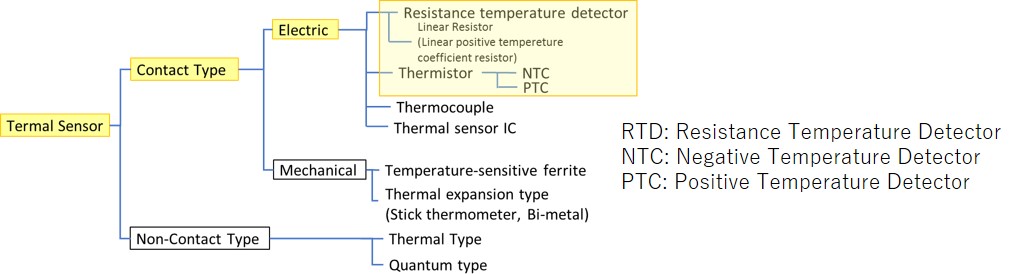
Thermal sensors are categorized as shown in the figure below, and there are "non-contact type" that measures temperature by brightness, color and infrared intensity, and "contact type" that uses changes in thermoelectromotive force, electric resistance and magnetism. The most widely used of these is the "electrical" resistance thermal sensor, which is easy to convert into an electrical signal.
There are various types of resistance thermal sensors, such as resistance temperature detectors using Pt, linear resistors, thermistors. In the past, thermistors were widely used in many cases, but recently, more of linear resistors having linearity of temperature coefficient and platinum resistance thermometers are adopted due to requirements such as temperature measurement accuracy, long-term stability, and compatibility.
Temperature characteristics of resistance thermal sensor
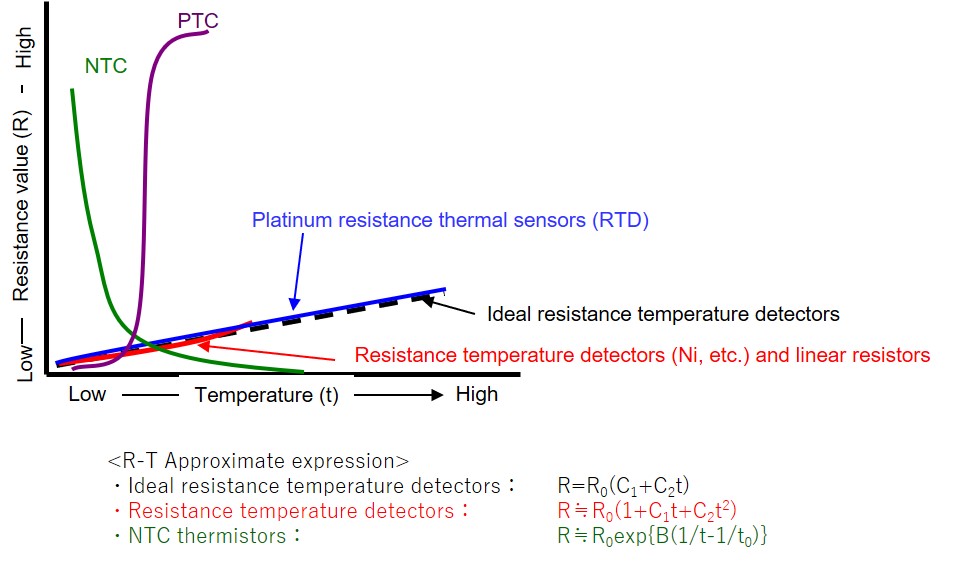
The types of thermal sensors whose resistance changes with temperature are roughly classified into thermistors, linear resistors, and platinum resistance thermal sensors. The temperature characteristics of each are shown below.
Characteristics of thermal sensor
Resistance temperature detector(RTD)
Resistance temperature detectors have the characteristic that the resistance value increases linearly with increasing temperature. Platinum resistance thermometers are particularly excellent in linearity and long-term stability. They can be used over a wide temperature range and their resistance tolerance and T.C.R tolerance are highly accurate. The platinum resistance thermal sensors Pt100 (100Ω at 0 ºC) is used as a standard in JIS standard, and there are other variations within the range of 10Ω to 1kΩ.
・Resistance value change of the resistance temperature detectors is almost linear to the temperature
・Use metals such as platinum, nickel and copper
・Platinum has excellent stability and linearity and covers a wide temperature range.
Linear Resistors
Linear resistors have a characteristic that resistance increases linearly with increasing temperature, but they are not as accurate as platinum resistance thermal sensors. It has long been used for temperature compensation of motor windings, and in recent years it has also been used for temperature compensation of high-frequency circuits and displays.
・Uses a point where the resistance increases almost linearly with temperature.
・Uses the alloy of Nickel and Palladium.
・Various resistance values and T.C.R. can be selected.
Thermistor (PTC/NTC)
Thermistors are elements whose resistance varies with temperature. There are two types of thermistors: PTC type (positive characteristic), in which the resistance increases as the temperature increases, and NTC type (negative characteristic), in which the resistance decreases as the temperature increases.
The resistance value of PTC types increases rapidly at a certain temperature. These characteristics are used to protect semiconductors from overcurrent during thermal runaway.
The resistance value of NTC types decreases exponentially with increasing temperature, and is high at room temperature, and the amount of its change with temperature is large. NTC types are generally used in protection circuits for secondary batteries of smartphones and others and are used the most among temperature sensors. Since NTC thermistors have a relatively large aging variation, design considerations are required for equipment that requires long-term reliability.
Since the term thermistor generally refers to NTC type, NTC thermistors will be referred to as thermistors hereafter.
<Temperature characteristics of NTC thermistors>
The resistance value R at t°C is approximately given below
R=Ro・exp{B(1/T-1/To)}
R :Resistance value at temperature T (K) * T(K) = t(℃)+ 273.15
Ro:Resistance value at temperature To (K)
B :This is called B constant and its unit is (K)
In the thermistor catalog, the resistance value at 25 ° C is described as Ro.
・Utilizing resistance temperature characteristics of semiconductors
・Is small and highly sensitive
・Has nonlinear resistance temperature change characteristics
・Large aging variation
Operating temperature range and accuracy
The operating temperature range and accuracy differ depending on the type of thermal sensor.

Comparison between resistance temperature detector and linear resistors
Resistance temperature detector
Features
・High linearity accuracy
Example)Tolerance for temperature of Pt100
・Class A:±(0.15+0.002 |t| )℃
・Class B:±(0.3+0.005 |t| )℃
・Pt100 has been standardized
・Few options of resistance and T.C.R.
・To be used under a condition with low self-heating
Fig. Pt100 R-V Characteristic (Excerpted)
|
Temp.(℃) |
0 |
-1 |
-2 |
-3 |
-4 |
-5 |
-6 |
-7 |
-8 |
-9 |
|
-50 |
82.04 |
81.67 |
81.31 |
80.94 |
80.58 |
80.22 |
|
|
|
|
|
-40 |
85.66 |
85.29 |
84.93 |
84.57 |
84.21 |
83.85 |
83.49 |
83.12 |
82.76 |
82.40 |
|
-30 |
89.26 |
88.90 |
88.54 |
88.18 |
87.82 |
87.46 |
87.10 |
86.74 |
86.38 |
86.02 |
|
-20 |
92.85 |
92.49 |
92.13 |
91.78 |
91.42 |
91.06 |
90.70 |
90.34 |
89.98 |
89.62 |
|
-10 |
96.43 |
96.07 |
95.72 |
95.36 |
95.00 |
94.64 |
94.29 |
93.93 |
93.57 |
93.21 |
|
0 |
100.00 |
99.64 |
99.29 |
98.93 |
98.57 |
98.22 |
97.86 |
97.50 |
97.15 |
96.79 |
Linear resistors
Features
・Low linearity accuracy
・Wide variety of resistance values
・Many variety of T.C.R.
・High power rating

T.C.R. (Linear resistors)
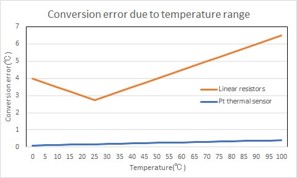
Temperature conversion error
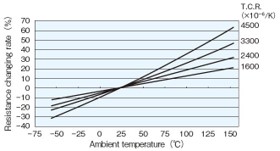
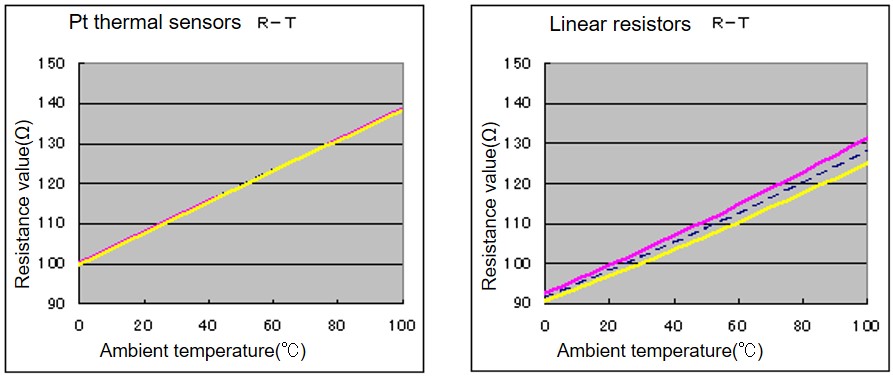
The temperature characteristics of the linear resistor being different between Cold T.C.R. and Hot T.C.R. divided at 25 ºC.
The platinum resistance thermometers have stable T.C.R. within the operating temperature range.
Variation in temperature characteristics
Summary
Each thermal sensor has various characteristics. For temperature control and temperature measurement, it is necessary to understand the characteristics of each and use them properly.
|
|
Resistance temperature detector |
Linear resistors |
NTC thermistors |
|
|
Pt(Platinum) |
Other metals |
|||
|
Measurement accuracy |
Excellent |
Good |
Poor |
Fair |
|
Stability |
Excellent |
Fair |
Fair |
Fair |
|
Resolution |
Fair |
Fair |
Fair |
Excellent |
|
Measuring temperature range |
Good |
Fair |
Fair |
Fair |
|
Temperature measuring correction circuit |
Unnecessary |
Unnecessary |
- |
Necessary |
|
Compatibility |
Excellent |
Good |
Fair |
Fair |
|
Selectivity |
Poor |
Fair |
Excellent |
Excellent |
|
Application |
Temperature measurement |
Temperature measurement |
Temperature compensation |
Circuit protection |

